
When our team first started tracking carts, we did what everyone does first: stuck cheap finder tags on them. Easy, inexpensive, and — it didn't work. Batteries died in months, locations were fuzzy, and there was no usable data: no fleet counts, no loss trends, nothing. As the location tech got better, a bigger gap appeared, and it wasn't accuracy. You still have to go get the cart. Three hundred pins on a map is not a retrieval plan; it's a headache with coordinates.
Store managers are busy. Nobody is going to stare at a cart map all day and text coordinates to a retrieval crew. For tracking to work operationally, the system has to make retrieval easy for the person actually driving the truck. QuickTrack closes that loop three ways:
Cloud-based location solving. The tracker doesn't burn battery computing positions — it sends raw data, and the software fuses GPS, Wi-Fi, and cellular signals into a location that's typically accurate within 30 feet. Smarter algorithms, longer battery life, and a pin close enough to walk to.
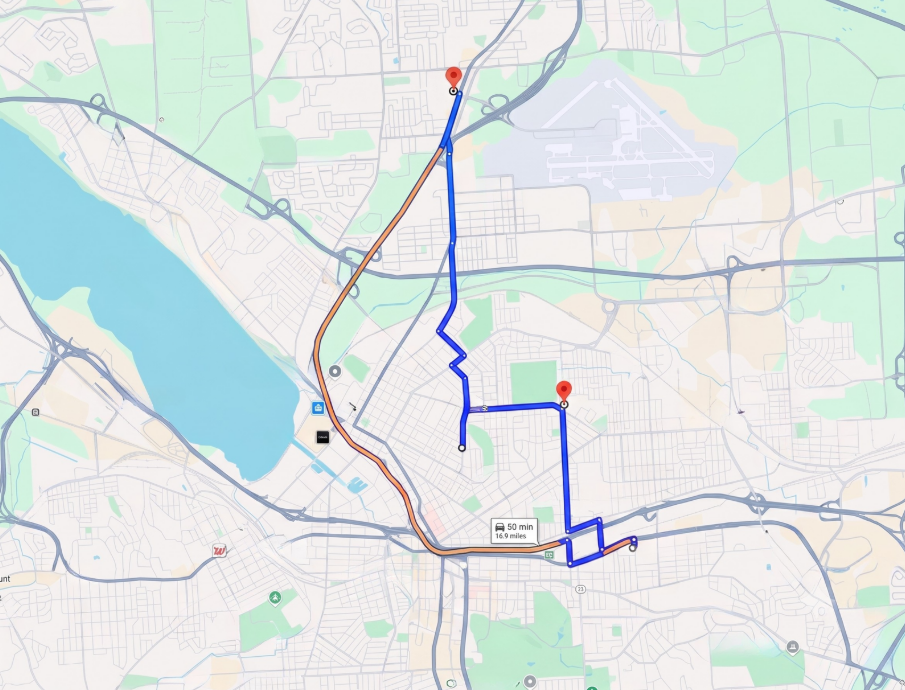
Built-in retrieval routing. Any off-property cart can be added to a recovery list — or Express Route, QuickTrack's routing capability, picks the most recoverable carts automatically and builds an optimized run on a schedule, delivered to your team or your retrieval partner without anyone logging in.
Google Maps as the only app anyone needs. Every route exports as a Google Maps link. Your retrieval partner doesn't touch your software, doesn't get an account, doesn't learn a new tool. They tap a link that's already on their phone; you keep control of your data.
A pin tells you where a cart is. A route brings it home. See the difference at QuickTrack, or start with the Cart Retrieval Guide.