
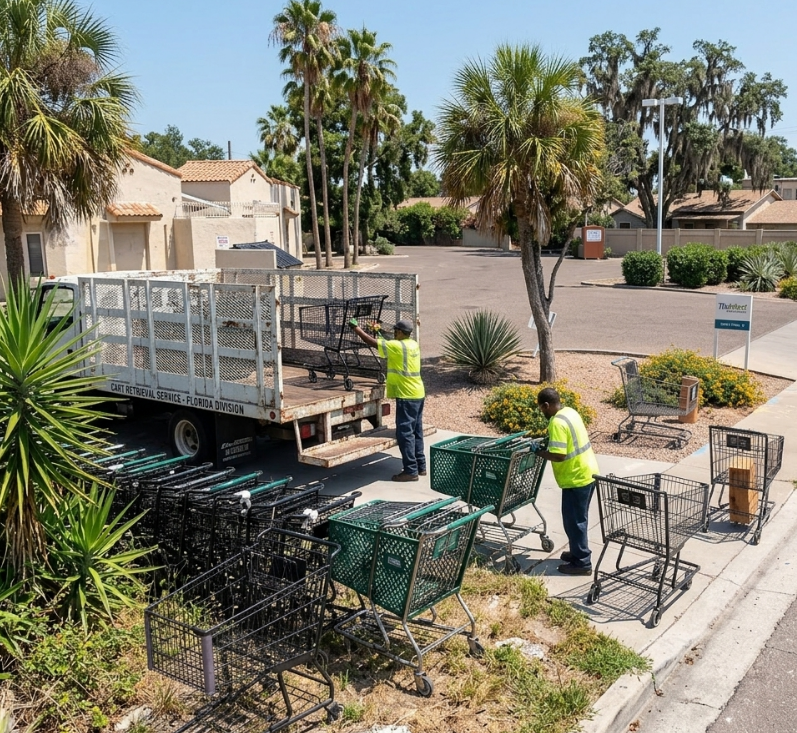
The short answer: Miami and Tampa — Florida’s two biggest cities — both structure their shopping-cart ordinances around retrieval, not containment. You can comply by running a plan to get carts back. Neither ordinance requires a physical locking mechanism on the cart. If you’ve been told compliance means wheel-locks, these two ordinances say otherwise.
Start with Tampa. Its ordinance requires each retailer to develop and implement a specific plan to retrieve its carts from around the city, and to submit that plan to the city for review. Carts need an ID with a retrieval phone number, and stores need removal-warning signage inside. That’s the whole obligation. There is no clause requiring a locking wheel, a physical barrier, or any hardware on the cart — a retrieval plan, done well, is compliance.
Miami writes it as a menu. A retailer complies by carrying out a plan using any one or more of a listed set of methods — and the list includes a daily cart-collection program as a standalone option, right alongside electronic wheel-locks, physical barriers, and alarms. In other words, the city hands you a choice and puts “go get your carts” on equal footing with “lock them down.” You don’t have to pick containment. You can satisfy the ordinance with recovery.
This matters because the two paths cost very different things and do very different work. A locking wheel is a fixed cost per cart that acts at the property line and stops helping the moment a cart clears the lot — and across the fleets we track, 43% of off-property carts end up more than half a mile from the store, well past where a wheel or an employee on foot ever reaches. A retrieval plan, by contrast, is aimed exactly at those carts: find the ones that left, route a run, bring them back. That’s the compliance the ordinance is really asking for, and it’s the part of the job that actually recovers the asset.
A tracked fleet turns “develop and implement a retrieval plan” from a paragraph in a city file into something you can actually run. You know which carts are off-property and where, a routed run brings back about 92% of the carts it targets, and roughly 79% of the fleet stays in service instead of turning into replacement POs. That’s a plan a city will recognize — and one that pays for itself even in cities that never send a notice.
Miami and Tampa aren’t special cases. Most of the 66 municipalities across 19 states we track are built the same way: retrieval-first, containment-optional. If someone’s told you compliance requires locking wheels, read your city’s ordinance before you buy the hardware. Start on the ordinance map.