
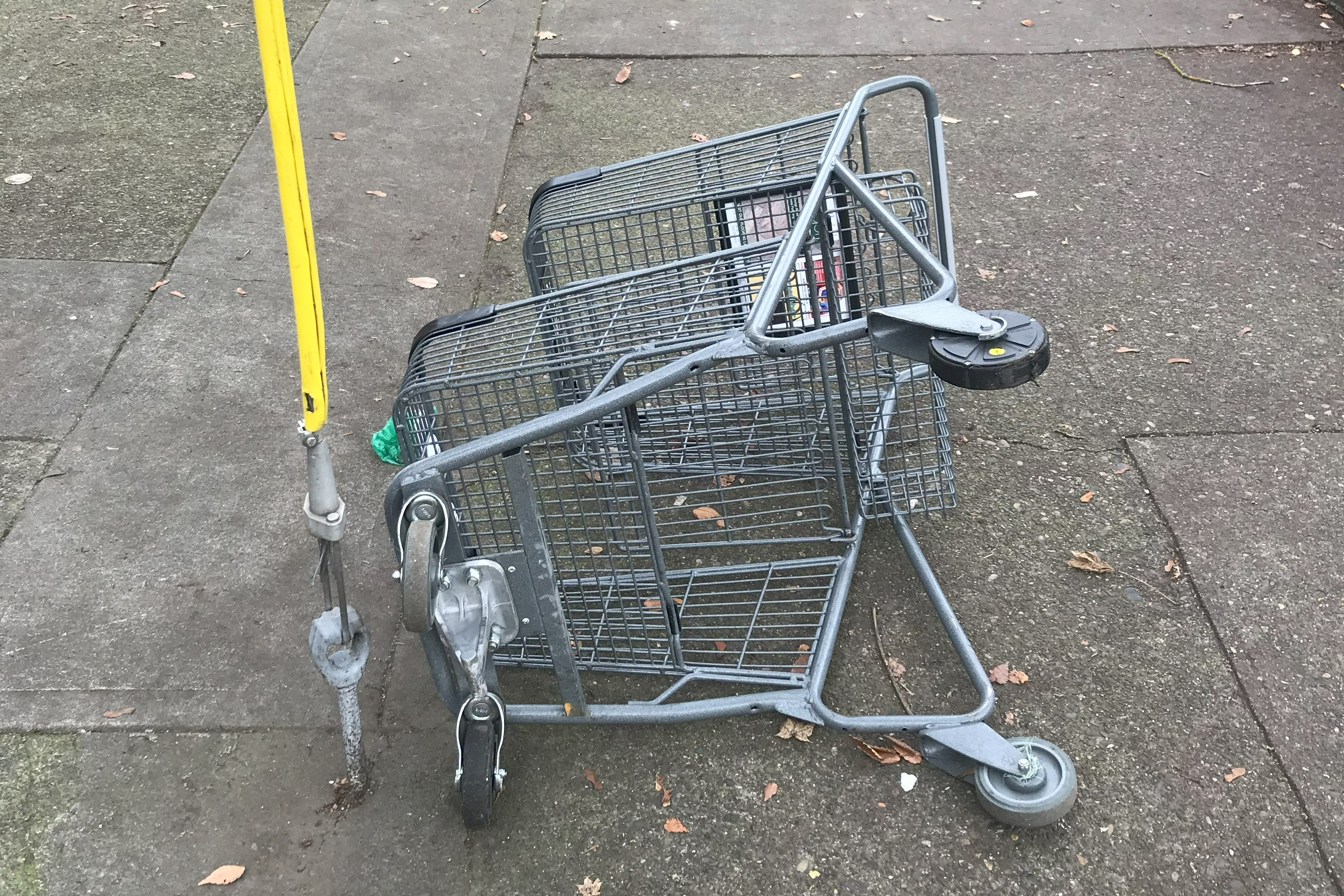
The short answer: a cart retrieval plan is an operational document, not a technology purchase. Cities want five things in writing — how your carts are identified, what you do to keep them on the property, how fast you get them back, who does the retrieving, and how you prove any of it happened. Get those five right and most ordinances are satisfied without buying a single piece of hardware.
The word “plan” is doing a lot of work in these ordinances, and it trips people up. A retailer reads “shopping cart containment and retrieval plan,” assumes it means equipment, and starts pricing wheels. The document the city clerk actually wants is closer to a standard operating procedure. Here is what goes in it.
1. Identification. Every ordinance starts here, and it is the requirement most often failed. Carts need a permanent, legible marking with the owner’s name and a way to reach them — increasingly a phone number and, in at least one recently amended code, an email address. Cities enforce this hard for an obvious reason: an unmarked cart cannot be billed to anyone, so several codes let the city scrap untagged carts outright. If your carts are not tagged, nothing else in your plan matters.
2. Prevention measures — and the menu they come from. This is the section people misread. Most ordinances list containment options rather than mandating one: physical devices, deposit systems, courtesy clerks or attendants, on-site barriers, employee-assisted return, and in many codes an open-ended “other measures approved by the city.” One large California city requires retailers above a certain fleet size to pick at least one from a list where a retrieval-service agreement sits alongside a wheel-locking device as an equal option. Read the conjunctions carefully. “Shall include at least one of the following” is a very different sentence from “shall equip all carts with.”
3. The retrieval window. Twenty-four hours from notification is the most common standard, and several codes layer a proactive obligation on top — weekly sweeps regardless of whether anyone has complained. A handful run tighter: retrieval within one hour of closing, or all carts indoors overnight. Escalation clauses are common too, moving a repeat offender from weekly to twice-weekly to daily retrieval. Whatever the number, the plan has to state it and commit to it.
4. Who actually goes and gets them. Cities want a named mechanism, not an intention. Employees on shift, a contracted retrieval service, or a defined internal route — any of these satisfies the requirement, but “we pick them up when we see them” does not. Where a retrieval service is named as a compliance path, the ordinance usually specifies its cadence, which is the city’s way of making the commitment auditable.
5. Records, and the annual paperwork. The part that gets skipped. Several codes require an annual certification with a hard filing deadline, and others want monthly logs of retrieval activity. Enforcement, when it comes, is almost always a documentation question first: show us the plan on file, show us the runs. A program you cannot evidence is a program the city treats as nonexistent.
One more thing worth knowing before you write anything: check whether the ordinance scales by fleet size. It is common for the plan requirement to switch on at a low cart count — one major city starts at 26 — with a stricter tier at a higher one. Operators assume these rules are aimed at big-box stores and find out otherwise.
The through-line across all five sections is that the city is asking a question about capability, not equipment: do you know where your carts are, and can you show what you did about it. Of the 95 ordinances on our map, 85 are structured exactly that way. That is the same answer whether you are filing your first plan or defending your fifth year of one — more on the mechanics at cart loss and retrieval, and the comparison at tracking vs. retrieval-only services.